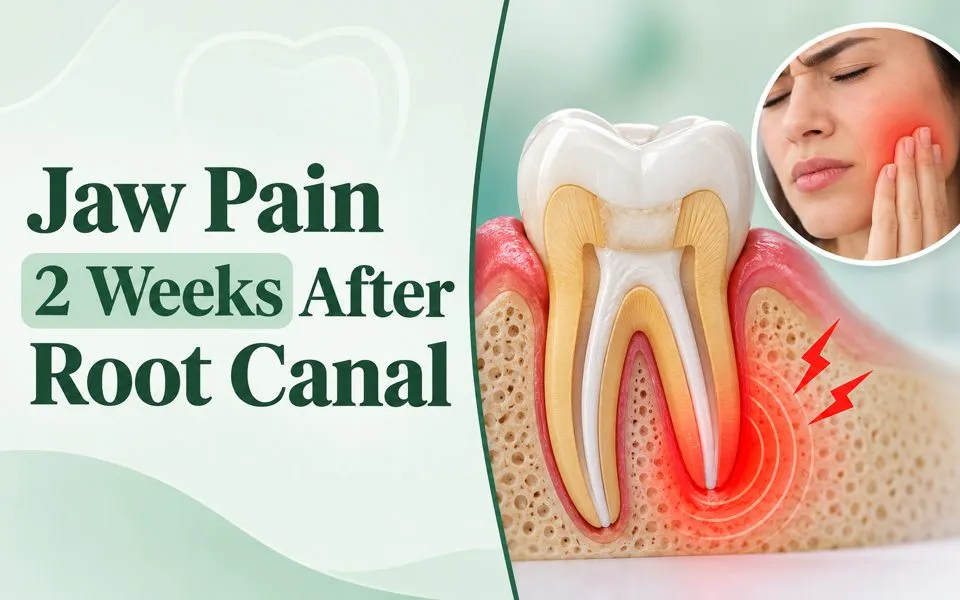
Is It Normal for My Jaw to Hurt 2 Weeks After a Root Canal?
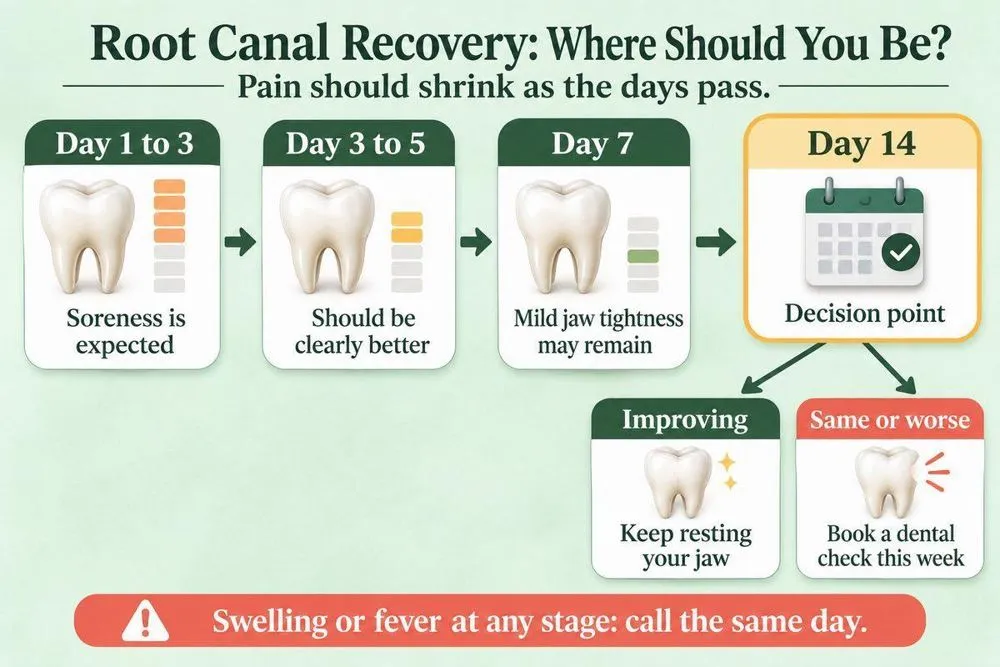
Yes, it can be. It is common to experience some mild jaw discomfort for up to 2 weeks after your root canal. This is usually due to the lengthy time with your mouth open and the use of local anaesthetic. Most people will feel much better within 3-5 days. If, however, on day 14 you are experiencing continuous pain, increasing pain or tooth-specific pain then we recommend seeing your dentist this week. If you have any root canal pain after 2 weeks, we recommend seeing your dentist. If you are experiencing any swelling, fever, pus or a bad taste we recommend calling the same day.
Expert view: The American Association of Endodontists says most patients experience mild discomfort for 3-5 days. If you are experiencing prolonged or increasing pain then this should be investigated by your dentist.
Why Is My Jaw Still Causing Me Pain 2 Weeks After My Root Canal?
Pain can be caused by either your jaw or your tooth.
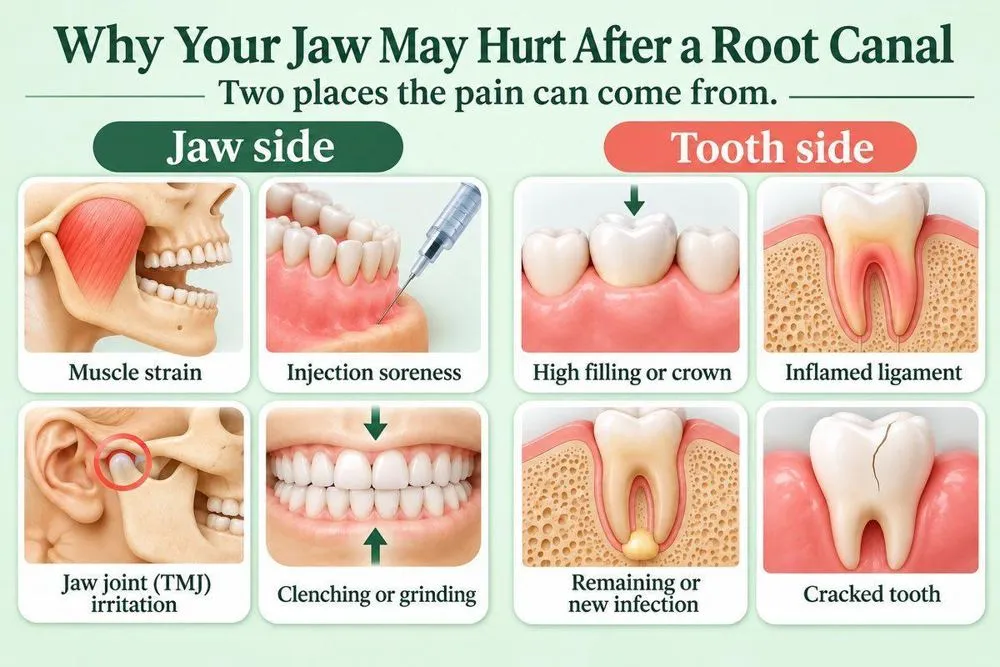
Causes related to your jaw:
- Soreness from prolonged opening of the mouth.
- Soreness from local anaesthetic injection (more common for lower teeth).
- Irritation of the jaw joint (TMJ).
- Bruxing / clenching (bruxism).
Causes related to your tooth:
- Filling or crown that is too high.
- Inflammation of the ligament around the root.
- This could be due to a missed canal or a leaking seal.
- Cracked tooth.
A common cause of jaw pain 2 weeks after root canal treatment is a prolonged appointment on a lower molar. By day 5 everything will seem fine in the tooth but you may notice soreness in the muscle in front of your ear when yawning. This points to jaw ache after root canal treatment rather than a problem with the tooth.
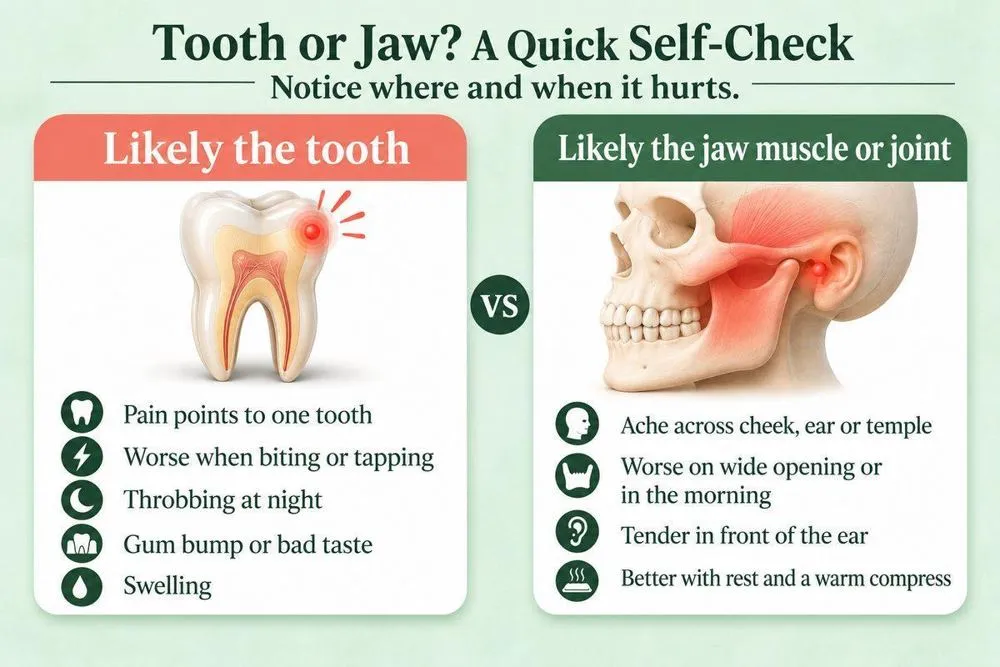
How Do I Know If It Is Coming From My Tooth, Jaw or Other Causes?
Refer to the chart below. This is just a guide and we would recommend visiting your dentist, who will usually be able to identify the cause in one appointment. The National Institute of Dental and Craniofacial Research states that mouth, jaw and facial pain may or may not relate to a jaw joint disorder. Other causes will often be ruled out first. The right-hand side of the chart shows causes related to TMJ after root canal treatment.
How Long Should It Take Me to Recover After My Root Canal?
Your pain should subside over time. However, if you still have root canal pain after 2 weeks then it is time to book an appointment.
If your tooth has a temporary filling then you should book an appointment for your permanent filling / crown on the date given by your dentist. Your tooth will be under full pressure when chewing so it can leak or crack.
Can a High Filling or Crown Cause Jaw Pain After a Root Canal?
Yes. If your filling / crown is slightly raised above your natural bite then every time you close your mouth this tooth will hit first, causing soreness. This can cause you to feel pain along your jaw. A high bite after root canal treatment is one of the most common causes of pain not settling.
Signs of a high bite:
- Raised tooth compared to others.
- Pain when teeth meet (even if no food is present).
- Pain started or worsened after final filling / dental crown.
A high bite after root canal treatment is usually an easy fix. Your dentist will highlight the high area and reduce it.
Can Bruxing / Clenching Cause Jaw Pain After a Root Canal?
Yes. Prolonged opening of the mouth can cause irritation to the joint and muscles. Many people will also clench unknowingly due to being stressed after treatment. TMJ after root canal treatment is usually a short-lived flare-up.
Common symptoms include a dull ache (worse in the morning), soreness in front of the ear and pain when opening wide. Some people will also experience ear pain after root canal treatment or a headache at the temple. Many of these issues will resolve themselves. Clicking without pain is common and does not need any treatment according to the NIDCR guide to jaw joint disorders.
What can help?
- Try to keep your lips closed and teeth slightly apart.
- Avoid wide yawning and chewing gum.
- If your jaw feels tight on waking let your dentist know.
Could It Be Another Tooth or My Sinus?
Yes. If a neighbouring tooth is decayed or your wisdom teeth are partially erupted you may feel a dull ache along the whole side of your jaw. This will often be blamed on the root canal-treated tooth even though it is healing well. Upper back teeth are very close to your sinus so if you are suffering from a blocked nose, pressure behind your cheek or pain which gets worse when leaning forward this could be the cause.
If your upper tooth was treated then ear pain after root canal treatment could also be due to your sinus. Let your dentist know about these symptoms. Pain will not be resolved if the incorrect tooth is treated.
How Can I Alleviate Jaw Pain After a Root Canal at Home?
Your pain should subside over time. However, if you still have root canal pain after 2 weeks then it is time to book an appointment.
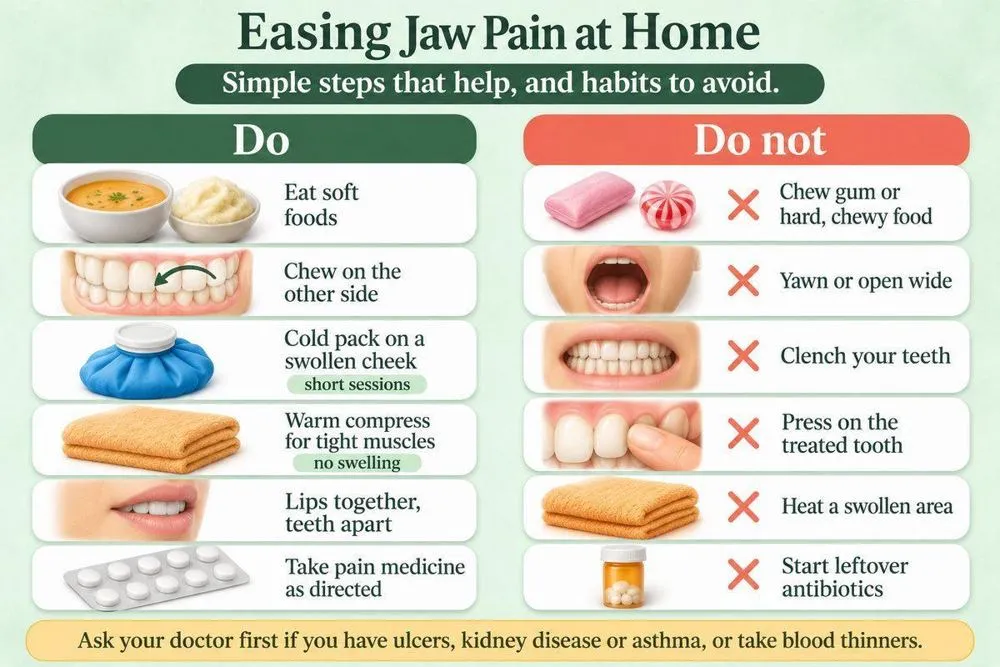
Take painkillers as instructed on the packet or by your dentist. If you suffer from ulcers in your stomach, kidney disease, asthma or are taking blood thinners speak to your doctor first. Do not take any leftover antibiotics as they will not help with muscle, joint or bite pain.
When Should I Contact My Dentist?
Call today: Swelling, fever, pus or a bad taste.
Book this week: On day 14: continuous pain, increasing pain or tooth-specific pain.
Mention at your next appointment: Jaw feels tight on waking.
A pimple-like lump on your gum could indicate an infection is draining. This is not coming from your jaw muscle.
Most pain will subside. However, a large review of root canal studies found that approximately 5 in 100 treated teeth were still experiencing pain 6 months or longer after treatment (Nixdorf et al., Journal of Endodontics). If you still have root canal pain after 2 weeks then book an appointment.
What Will My Dentist Do?
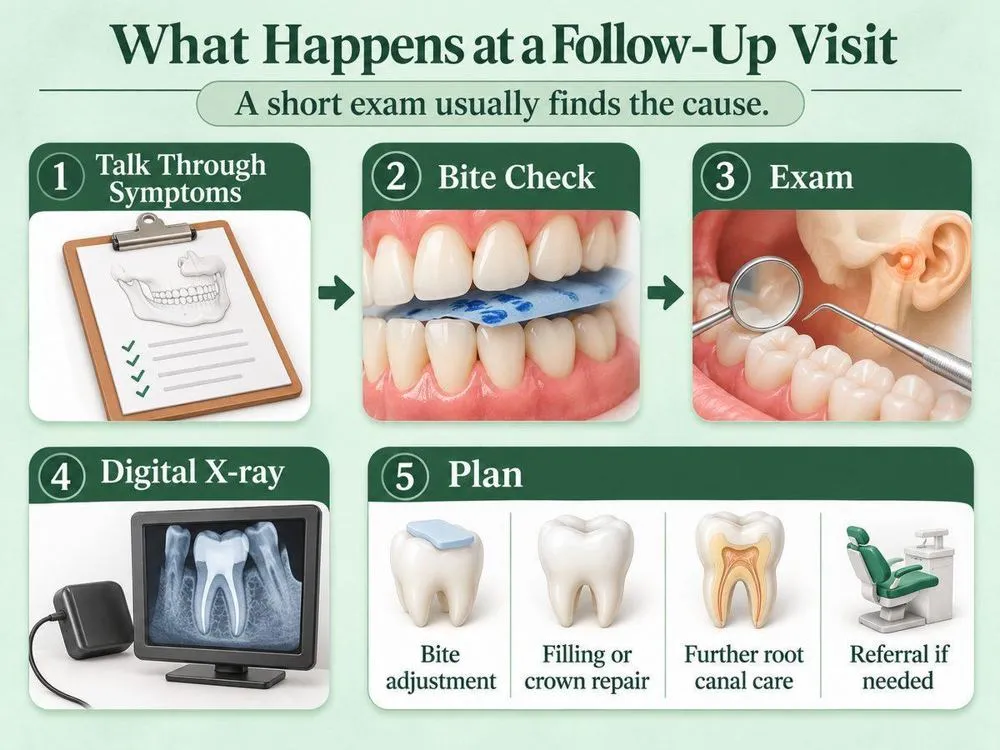
Depending on your examination and x-ray your dentist may:
- Adjust your bite if it is a high bite after root canal treatment.
- Fix or replace any leaking fillings / crowns.
- Prescribe medication and rest for an inflamed ligament or irritated jaw.
- Further root canal treatment if there is an infection.
- Rarely remove the tooth and fit a dental implant if the tooth cannot be saved due to a crack.
How Can Enamel Dental Help?
Our practice in Banjara Hills, Hyderabad is led by Dr. Namratha Chandrahari, who is a globally trained prosthodontist. We have fitted over 10,000 implants and completed 500 full mouth rehabilitation cases. Our area of expertise includes crowns and occlusion which are common causes of persistent pain after root canal treatment.
If you are still experiencing pain after 2 weeks we can:
- Perform an examination and digital x-ray to determine if the pain is coming from your tooth, bite or jaw.
- Root canal treatment: Assess the treated tooth and provide further root canal treatment if required.
- Zirconium crowns and bite adjustment: Check your bite and reshape or replace the crown if this is causing pain.
- Gum and soft tissue laser treatment: This reduces any discomfort and speeds up healing.
- Complex cases (full mouth rehabilitation): Multiple teeth and your bite will be planned together.
If your pain is still there after 2 weeks, get it checked. A short examination and an x-ray are usually enough to show whether the cause is the tooth, the bite or the jaw, and the right fix depends on that.

Still in pain after 2 weeks?
Get the cause found with a short exam and digital x-ray.
Disclaimer: This article is for educational purposes only and should not replace an examination by your dentist.
FAQ
Does jaw pain after root canal mean it has failed?
Usually not. More commonly it is caused by muscle pain from your jaw, soreness from the injection and a high bite. Often mild jaw ache after root canal treatment is caused by a muscle. However, if your pain is not settling after 2 weeks an examination is required.
How long does jaw pain last after a root canal?
Most discomfort will subside after 3-5 days. Stiffness in the jaw can last 1-2 weeks. If you are feeling jaw ache after root canal treatment for longer than 2 weeks or it is getting worse then see a dentist.
Why does my ear hurt after my root canal?
Ear pain after root canal treatment is often referred pain. Your jaw, teeth and ear nerves are all closely connected. If there is strain on your jaw muscle or joint then this can cause ear pain. If you are experiencing any swelling, fever or worsening tooth pain then see a dentist.
Can a root canal cause TMJ issues?
The joint can be irritated during a long appointment. This will mostly affect those who already clench or have a clicking painful joint. Many flare-ups will resolve, so TMJ after root canal treatment is rarely a long-term issue.
Do I need antibiotics for jaw pain after root canal?
Only if prescribed by your dentist after examination. Antibiotics will not help with muscle, joint or bite pain.
References
- American Association of Endodontists. Root Canal Pain and Comfort
- American Association of Endodontists. Root Canal Explained
- National Institute of Dental and Craniofacial Research. Temporomandibular Disorders (TMD)
- Nixdorf DR et al. Frequency of persistent tooth pain after root canal therapy: a systematic review and meta-analysis. J Endod 2010. PubMed
- Martins ED et al. Prevalence of persistent pain after endodontic treatment: a systematic review and meta-analysis. Braz J Oral Sci. Abstract