Pterygoid Implants in Banjara Hills, Hyderabad

Pterygoid Implants Treament

The replacement of missing teeth in the back of the upper jaw can be challenging when there is limited bone available for conventional implants. Pterygoid implants offer an alternative for selected patients by anchoring into the dense bone in the pterygoid area of the mouth, helping provide support for fixed teeth without relying entirely on the reduced bone near the sinus.

According to Dr. Namratha Chandrahari, an eminent dentist in Banjara Hills, Hyderabad, “The plan for complex dental implant treatments should be based on the patient’s anatomy and bite along with the final restoration. When there is not much bone available, the treatment approach needs to be carefully selected. Precise planning helps us use the available bone effectively while keeping function and long-term stability in focus.”

At Enamel Dental Clinic, Dr. Namratha brings extensive experience in implant dentistry and full-mouth rehabilitation. Her approach combines detailed diagnosis, 3D imaging, and prosthetic planning for complex cases. Patients considering Pterygoid implants in Banjara Hills, Hyderabad, can get an in-depth assessment to determine their suitability for such an implant system.
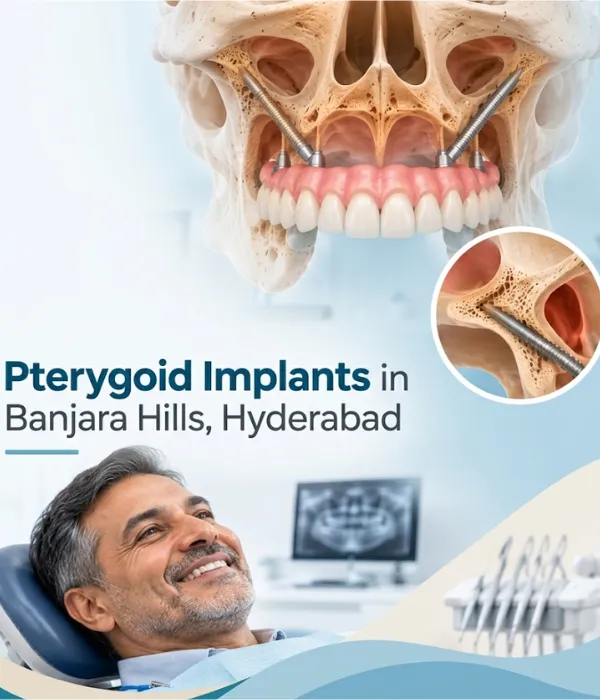
Promotional banner for Pterygoid Implants in Banjara Hills, Hyderabad, showing a skull model with dental implants and a smiling patient in a dental clinic.

How Do Pterygoid Implants Work?

Pterygoid implants are positioned in the posterior region of the upper jaw and engage the dense bone around the pterygomaxillary area. In selected cases, they provide support for implant-supported restorations.

They are particularly relevant when the posterior maxilla has reduced bone volume and conventional implant placement would be challenging.

Depending on the overall treatment plan, pterygoid implants may support:

Individual or multiple missing teeth

Implant-supported bridges

Full mouth dental implants in Banjara Hills, Hyderabad
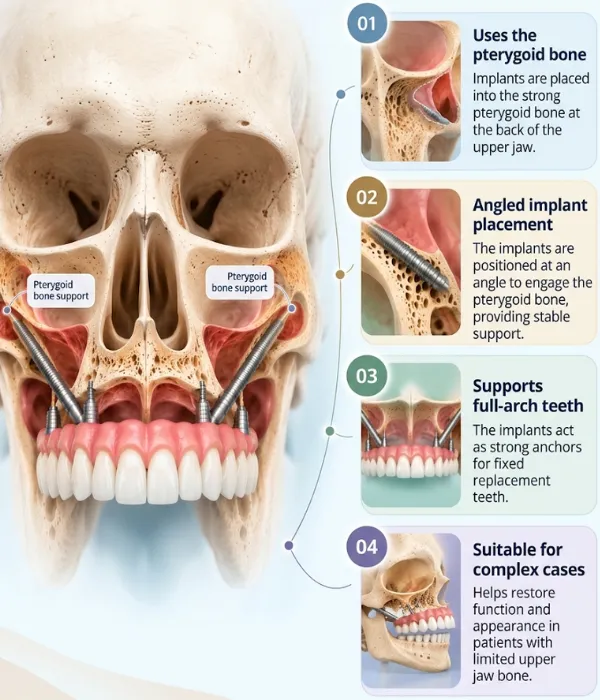
Full-arch fixed restorations
Comprehensive upper jaw rehabilitation
As in the case of implant placement, accurate planning is key due to the anatomical complexity of the posterior maxilla.
Skull diagram showing pterygoid implants anchored to the pterygoid bone with labeled arrows on the sides.

Book Your Appointment

Limited bone in the upper jaw can make implant planning challenging. Get an assessment to understand whether pterygoid implants may suit your case.
Could this technique be suitable for you? Let’s look at the cases
where it may be considered.

Who May Be Suitable for Pterygoid Implants?

Pterygoid implants may be considered for patients with:

They can also be considered when avoiding additional bone augmentation is part of the treatment discussion.

However, not everyone with bone loss is a candidate. Bone anatomy, sinus condition, overall health, bite, existing teeth, and the planned restoration all influence the decision.

For patients exploring Pterygoid implants in Banjara Hills, a specialist assessment is important before choosing between pterygoid implants, conventional implants, sinus procedures, or other implant solutions.
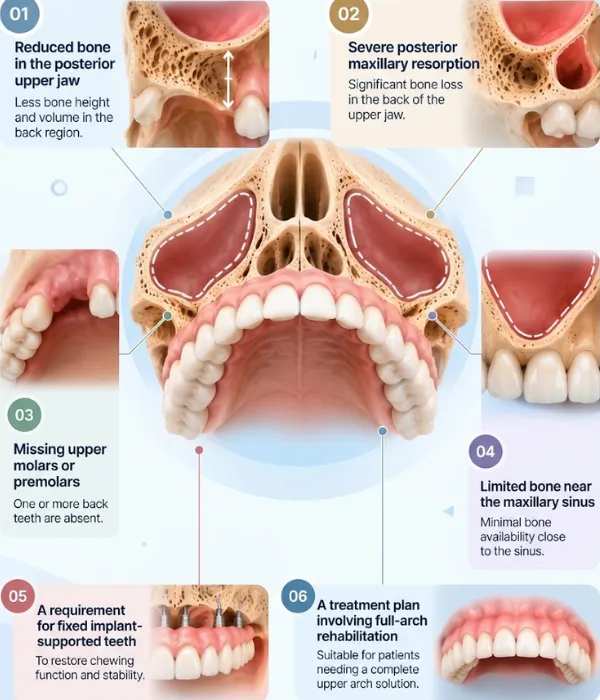
Infographic detailing six upper-jaw dental problems with callouts showing bone loss, missing teeth, and implants.
What does the treatment journey look like? Here are the main stages.

What Happens During Pterygoid Implant Treatment at Enamel Dental Clinic?
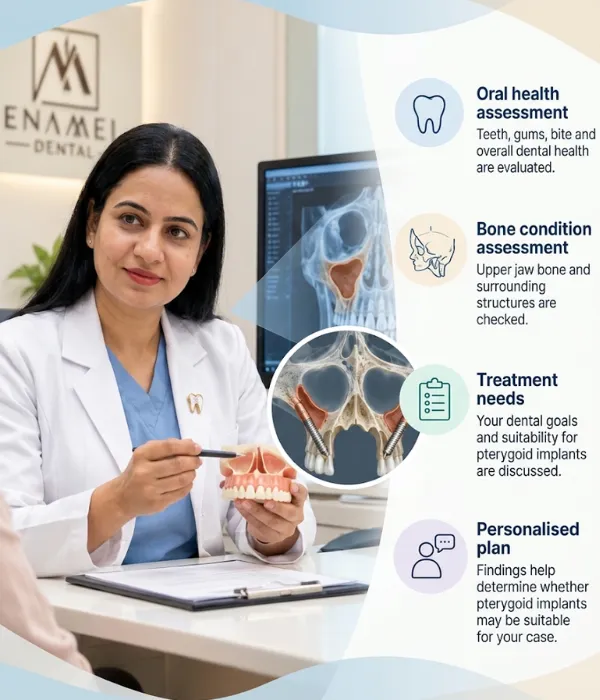
Dentist in a white coat explains a dental model to a patient, with an X-ray screen nearby and an infographic on the right about oral health.

Clinical Evaluation

Your teeth, gums, bite, bone condition, and missing-tooth areas are examined.
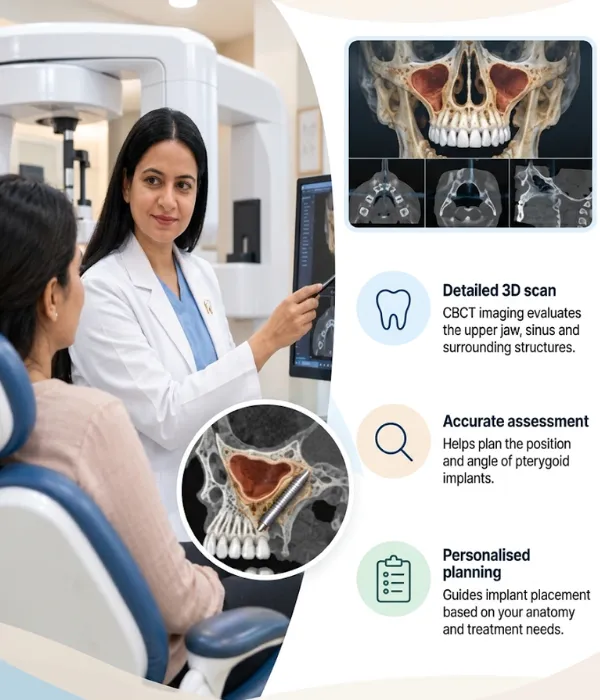
Dentist explains a 3D CBCT dental scan to a patient beside an imaging machine, with skull diagrams on a nearby screen and a close-up implant image.

3D Imaging

CBCT imaging may be used to assess the available bone and surrounding anatomical structures. Dr. Namratha offers CBCT-based planning for appropriate implant cases.
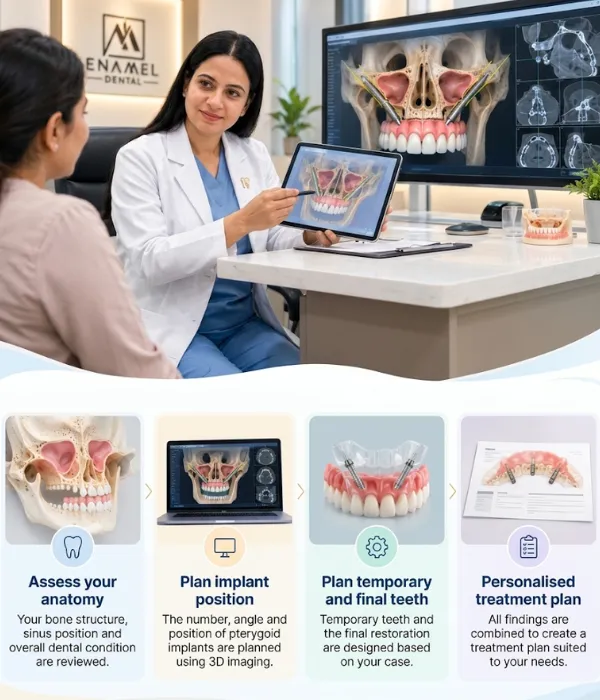
Dentist explains dental treatment to a patient using a tablet showing a 3D image of teeth in a modern clinic, with a medical monitor in the background.

Treatment Planning

Dr. Namratha plans the implant position according to the available bone and the design of the final restoration.
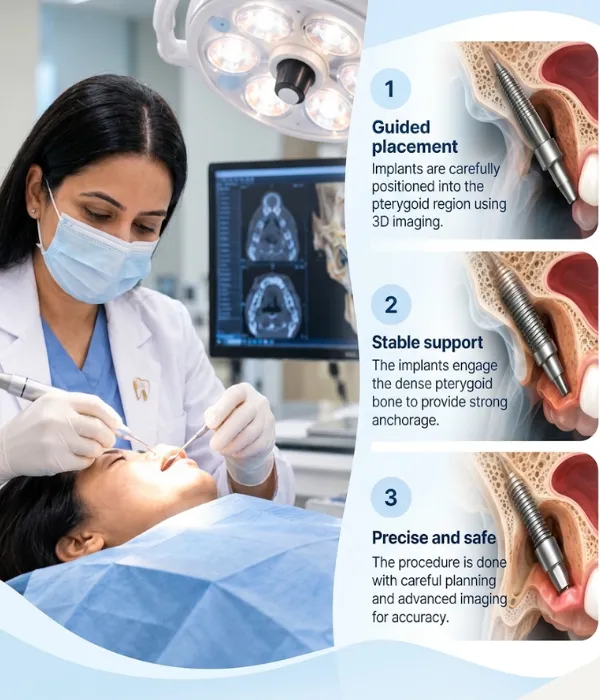
Dentist treating a patient while an implant infographic on the right explains the steps: guided placement using 3D imaging, stable support, and precise and safe procedure.

Implant Placement

The pterygoid implant is carefully positioned in the posterior maxillary region to obtain support from the dense pterygoid area.
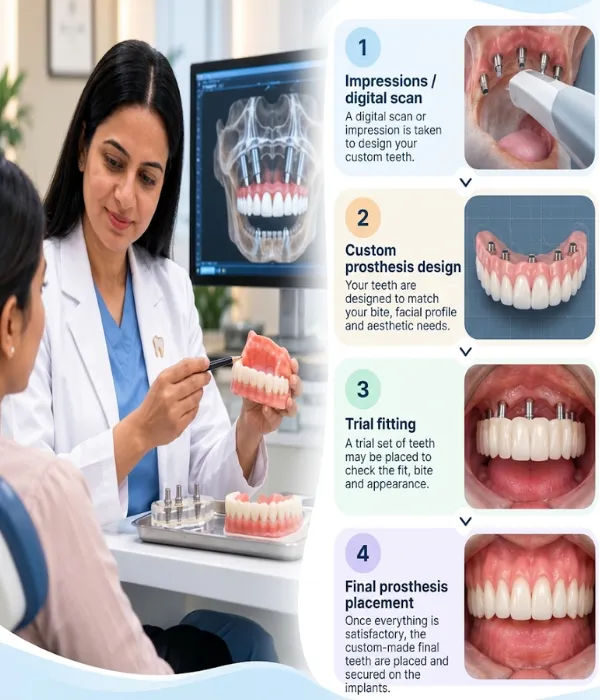
Dentist explains dental implants to a patient, holding a denture model with a jaw X-ray on the computer screen behind them.

Prosthetic Restoration

After appropriate assessment and healing, the implant can support a crown, bridge, or part of a larger fixed restoration depending on the treatment plan.
Pterygoid implants are often used alongside other implants when rehabilitating a larger section or full arch rather than functioning as an isolated treatment.
Every surgical procedure has considerations. Let’s look at what you should know before choosing pterygoid implants.

What Risks and Limitations Should You Understand Before Treatment?

Pterygoid implant placement is technically demanding because the implant is positioned in a posterior region with complex anatomy. Research supports its use in selected patients, but the procedure requires careful case selection and surgical planning.

Potential considerations include:

Complex posterior jaw anatomy
Surgical difficulty
Implant angulation and positioning
Sinus-related considerations
Risk of implant failure or complications
Need for appropriate prosthetic planning

What Recovery and Aftercare Guidance Can You Expect at Enamel Dental Clinic in Banjara Hills, Hyderabad?

Recovery varies depending on the number of implants, surgical complexity, individual healing, and the type of restoration provided.

After treatment, you may be advised to:

With the placement of your final restoration, regular cleaning around your implant-supported teeth will be necessary. This can be achieved by conducting periodic dental exams.

Step 01: Take medication as prescribed with a glass of water and capsules on a blue panel.

Book Your Appointment

Not sure which implant option suits you? Get in touch for a detailed evaluation to clarify your choices.

FAQ

1. Can Pterygoid Implants Avoid a Sinus Lift or Bone Graft?

Yes, in selected individuals, pterygoid implants can be placed without the need for the conventional sinus lift procedure or grafting.

2. Can I Get Pterygoid Implants If I Have Upper Jaw Bone Loss?

This may be considered in selected individuals who have posterior maxillary bone deficiency. However, imaging would be required to assess suitability.

3. How Long Does Healing Take After Pterygoid Implant Placement?

Healing varies between patients and depends on the implant plan and restoration. Your dentist will determine the appropriate loading and review schedule.

4. Is Pterygoid Implant Surgery Painful?

The procedure is performed under appropriate anaesthesia. Some soreness or swelling can occur afterward and is generally managed according to your dentist’s instructions.

5. How Should I Clean Around Pterygoid Implant-Supported Teeth?

Brush regularly but also clean between the teeth with the recommended dental hygiene aids. Your dental team can demonstrate the appropriate technique.

6. How Much Do Pterygoid Implants Cost in Banjara Hills, Hyderabad?

The cost of pterygoid implants in Banjara Hills, Hyderabad varies according to the number of implants, surgical complexity, diagnostic requirements, and final restoration. A consultation is needed for an individual estimate.
Disclaimer: The information shared in this content is for educational purposes and not for promotional use.
Call Now Button