
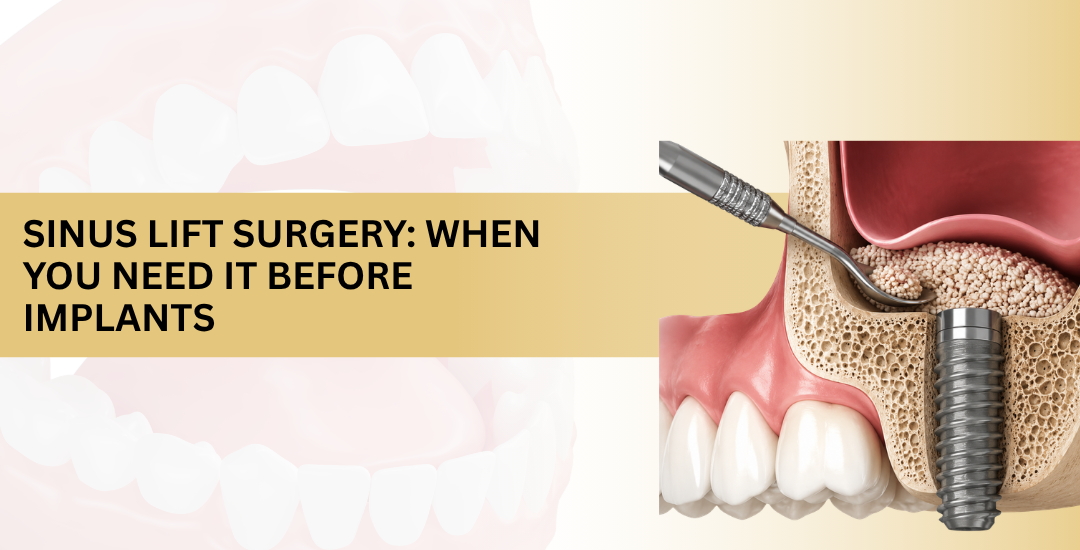
A sinus lift, also called sinus augmentation, is required before dental implants when the upper jaw (posterior maxilla) lacks sufficient bone height to securely anchor the implant. The procedure lifts the Schneiderian sinus membrane and packs bone graft material beneath it, creating a stable foundation for implant placement. It is typically needed in patients who have experienced bone resorption from long-term tooth loss, periodontal disease, or who have naturally low-sitting maxillary sinus cavities. Sinus elevation restores adequate bone volume so implants integrate firmly and last decades.
According to Dr. Namratha Chandrahari, Dental Clinic in Banjara Hills,Hyderabad, Bone density below 5mm in the posterior maxilla almost always demands a sinus elevation. Skipping it risks implant migration into the sinus cavity within months.
Not sure if you need one? Let’s look at the key indicators.
Who actually needs a sinus lift before getting implants?
Patients with less than 5mm of vertical bone between the alveolar crest and the maxillary sinus floor need sinus augmentation before implant placement. CBCT scans confirm the deficit.
- Bone height: Anything below 5mm of vertical bone between crest and sinus floor needs augmentation, no shortcuts here.
- Tooth loss timeline: Molars missing for 6+ months show measurable resorption. The longer the gap, worse the deficit.
- Sinus pneumatisation: Sinuses naturally drop after extractions, eating into available implant space without any warning.
- Failed previous implants: Earlier failures often trace back to inadequate bone. A lift fixes the root cause before retry.
CBCT imaging settles the question before surgery. And it’s non-negotiable for upper molar Dental Implants.
Wondering what happens in the chair? Let’s walk through the steps.
What does the sinus lift procedure actually involve?
The lateral window technique creates an opening in the upper jaw bone, elevates the sinus membrane, and packs bone graft material into the created space. Healing runs 4 to 9 months before implants can be placed.
- Anaesthesia: Local with sedation in most cases, general anaesthesia only for medically anxious patients or complex cases.
- Graft choice: Synthetic, bovine, or autogenous bone, sometimes combined with All-on-4 Dental Implants planning for full-arch cases.
- Membrane handling: The Schneiderian membrane is fragile. Tears below 5mm self-seal, larger ones need collagen patches.
- Closure: Resorbable sutures, antibiotic cover for 7 days, and zero blowing your nose for 2 weeks straight.
Healing runs 4 to 9 months depending on graft type. Zygomatic alternatives exist for extreme cases, covered in Zygomatic Implants.
Looking for the right specialist? Let’s see why expertise matters here.
Why Choose Dr. Namratha Chandrahari?
Dr. Namratha Chandrahari is a globally trained prosthodontist with 10,000+ implant placements and 500+ full-mouth rehabilitations to her credit. Sinus lifts at her practice use CBCT-guided planning and piezoelectric instrumentation. Full credentials and experience are detailed on the Dr. Namratha Chandrahari profile.
Patients with previously rejected implant candidacy regain eligibility through staged sinus augmentation here. No empty promises. Real bone, real outcomes, real implants that hold.

Book Your Appointment
Worried about insufficient upper jaw bone for implants?
FAQ
Is sinus lift surgery painful?
No. Local anaesthesia with sedation keeps the procedure painless, mild soreness lasts 3 to 5 days.
How long before implants can be placed after a sinus lift?
Usually 4 to 9 months, depending on graft material and individual healing response.
Can a sinus lift fail?
Rarely. Membrane perforation or infection causes most failures, both manageable with timely intervention.
Is the procedure covered by insurance?
Most Indian dental insurance plans exclude sinus lifts. Verify with your provider before scheduling.
Refrences:
