
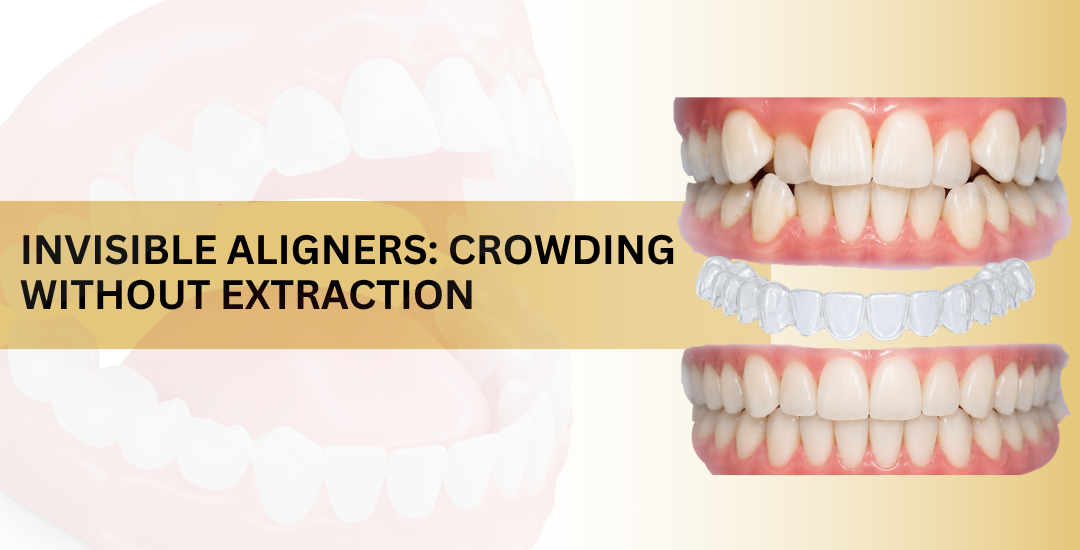
Invisible aligners correct mild to moderate dental crowding by applying controlled, sequential force through a series of custom thermoplastic trays, shifting teeth into available arch space without removing any teeth. Each tray moves specific teeth by 0.25 to 0.33 mm per stage. Mild crowding of up to 4 mm resolves through arch expansion and interproximal reduction; moderate crowding of 4 to 6 mm may need IPR (interproximal reduction), where a fine strip removes 0.1 to 0.3 mm of enamel between teeth to create room. Severe crowding beyond 6 mm still typically requires extraction, making clinical evaluation the deciding factor.
According to Dr. Namratha Chandrahari,a renowned dentist at Dental Clinic in Banjara Hills, “Adults presenting with moderate crowding don’t need extraction at all, provided the bone width supports controlled arch expansion and IPR is done precisely.”
How Do Aligners Create Space Without Removing Teeth?
Space management is the core of non-extraction aligner therapy. Three biomechanical techniques handle this, and clinicians choose based on the severity of crowding present.
- Arch Expansion: Aligners exert lateral pressure on posterior teeth, widening the dental arch by 1 to 2 mm per side, which frees room for anterior teeth to derotate and align without any tissue removal involved.
- IPR: A clinician uses a diamond-coated strip to remove a fraction of enamel between specific teeth, with total reduction rarely exceeding 0.5 mm per contact point, creating measurable space without affecting pulp integrity or long-term enamel health in the relevant tooth.
- Torque Control: Certain trays tip the roots of teeth buccally, increasing the functional arch perimeter slightly, which addresses up to 1 to 2 mm of crowding through root position changes rather than any physical removal of tooth structure.
- Derotation: Rotated teeth occupy more arch length than their actual mesiodistal width, so correcting rotation alone recovers space, often 0.5 to 1 mm per tooth, without touching adjacent teeth or requiring surgical intervention.
Combined across all four strategies, non-extraction aligner therapy can manage 5 to 6 mm of crowding in the right case. Smile designing is often planned alongside aligner completion when additional cosmetic refinements are needed post-alignment.
What Makes Someone a Good Candidate for Extraction-Free Aligner Treatment?
Not every crowding case qualifies. Patient anatomy and crowding severity define whether non-extraction aligner therapy will deliver stable results or fall short.
- Crowding Severity: Cases with less than 5 to 6 mm of total arch length discrepancy are the clearest candidates, since the IPR and expansion toolkit reliably handles this range without compromising root support or long-term periodontal health.
- Bone Width: Adequate alveolar bone in the posterior region must exist before expansion is attempted, because moving teeth beyond bone support risks dehiscence, which some laser dental treatment protocols can address but don’t eliminate as a risk.
- Root Length: Patients with short or tapered roots are poorer candidates for extensive torque movements, since root resorption risk rises with the magnitude of force applied over extended treatment periods.
- Patient Compliance: Aligners need 20 to 22 hours of daily wear to generate the planned tooth movement, and patients who remove them frequently see slower progress or incomplete correction regardless of case severity.
Here is where digital treatment planning makes the difference. A 3D simulation shows exactly how much space each method creates before a single tray is fabricated. See how this works in Invisalign vs Braces.
Why Choose Dr. Namratha Chandrahari?
The clinic is led by Dr. Namratha Chandrahari holds an MDS in Prosthodontics and a Fellowship from the Royal College of Surgeons, Ireland (MFD RCSI), with over 10,000 successful dental procedures including complex orthodontic and restorative cases. Her practice at Enamel Dental covers full digital treatment planning, 3D scanning, and staged aligner fabrication for both local and international patients.
Patients who complete aligner treatment here consistently report stable corrections with well-managed IPR outcomes. The focus isn’t on shortening treatment timelines but on getting the tooth position right the first time.

Book Your Appointment
Teeth pressing together despite enough arch space?
FAQ
What is the maximum crowding aligners can fix without extraction?
Most clinicians consider up to 5 to 6 mm of arch length discrepancy manageable without extraction using aligners.
Does IPR weaken teeth over time?
IPR removing 0.1 to 0.3 mm per contact does not compromise enamel integrity when performed with calibrated instruments.
How long does non-extraction aligner treatment take?
Mild crowding cases typically resolve in 6 to 9 months; moderate cases can take 12 to 18 months.
Can crowding come back after aligners?
Yes, relapse is possible without retainers; wearing retainers consistently after treatment maintains the corrected position.
References
