
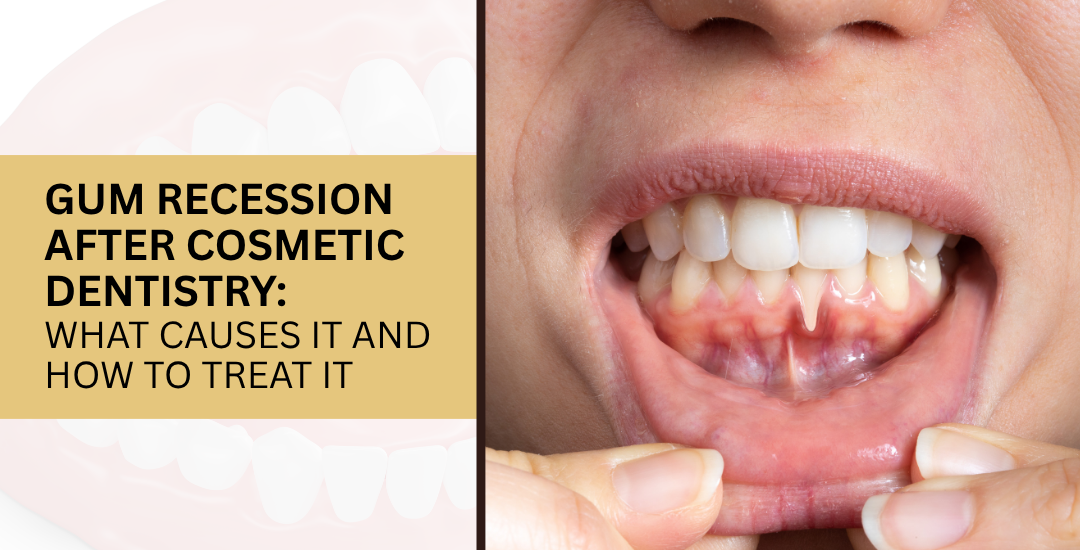
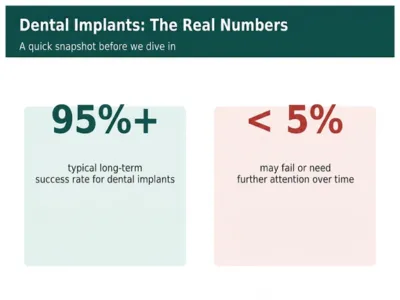
Most implants just work. Published success rates usually land somewhere north of 95%, and for the majority of patients that’s genuinely the whole story, nothing else to think about once healing wraps up. But a small slice don’t settle properly. Sometimes it’s obvious within a few months. Other times an implant does its job for years and then, out of nowhere, something feels wrong. Either way, don’t just wait it out and hope.
Dr. Namratha Chandrahari at Enamel Dental in Banjara Hills, Hyderabad, and she gets this question a lot: something feels a little off around an implant, but is it worth worrying about? Her answer is usually the same. “Catching it early is usually the difference between saving the implant and losing it,” she says.

Not sure if what you're feeling around your implant is normal?
Book a second opinion with Dr. Namratha Chandrahari at Enamel Dental →
What Is a Failed Dental Implant?
Three things usually cause it. The implant never fused with the jawbone the way it should have (dentists call this osseointegration). It’s come loose after functioning fine for a while. Or infection has quietly taken over the gum and bone around it. Different mechanisms, same end result: the implant can’t do a tooth root’s job anymore.
Dentists generally split this into two categories.
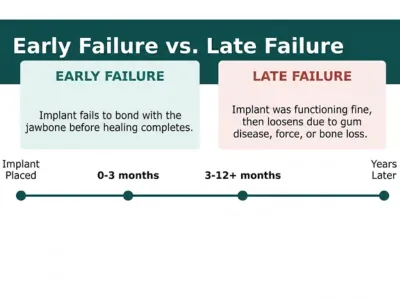
Late failure is different, it creeps in after the implant has already been working for a while, sometimes years, and it’s usually down to gum disease, grinding, or bone loss that nobody noticed until it had already progressed.
Common Causes of Dental Implant Failure
It’s almost never one thing. Biology, mechanics, daily habits, they tend to overlap. Knowing the usual suspects at least means you can ask better questions next time you’re in the chair, instead of just nodding along.
- Peri-implantitis: a gum infection that gradually breaks down the bone and tissue holding the implant in place.
- Poor osseointegration: in some cases, the implant simply never bonds properly with the underlying bone.
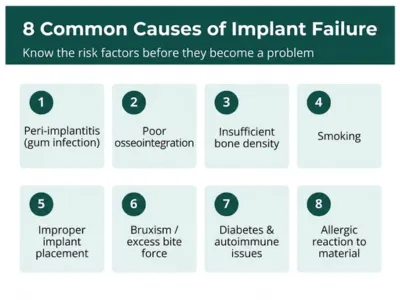
- Insufficient bone density: not enough bone volume for the implant to anchor securely.
- Smoking: it reduces blood flow to the gums, which noticeably raises the risk of failure.
- Improper implant placement: the wrong angle, depth, or position during the surgical procedure.
- Bruxism or heavy bite force: grinding places constant, abnormal stress on the implant.
- Diabetes and autoimmune conditions: these can interfere with how the surgical site heals.
- Allergic reaction to implant material: uncommon, but titanium sensitivity does occur in rare cases.
Symptoms of a Failed Dental Implant
The early signs are almost always small enough to shrug off. That’s kind of the trap. Don’t wait for something dramatic, watch for anything that’s changed.
- Persistent pain or discomfort: ongoing pain, particularly when biting down, is not normal once healing has finished.
- Swelling or inflammation: gum tissue near the implant that looks puffy, feels tender, or has changed colour.
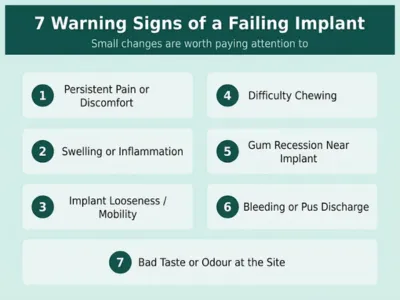
- Implant looseness or mobility: any wobble at all is a sign the implant isn’t stable.
- Difficulty chewing: pain or instability that makes ordinary chewing uncomfortable.
- Gum recession around the implant: tissue pulling back and exposing more of the implant than it should.
- Bleeding or pus discharge: a clear indicator of active infection.
- Bad taste or odour near the implant: often a sign of bacterial buildup happening beneath the surface.
When to See a Dentist Again
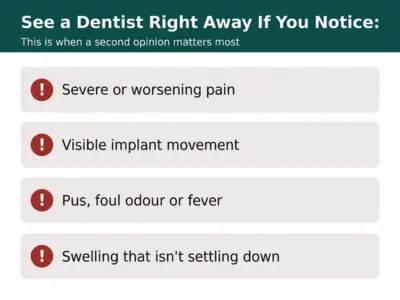
A few symptoms don’t deserve a wait-and-see approach. If you notice any of these, pick up the phone.
Timing changes everything here. Peri-implantitis caught early might just need a deep clean and a round of antibiotics. Left alone too long, removal ends up being the only thing left on the table.
“Patients often wait, hoping it’ll pass on its own,” Dr. Chandrahari says. “With implants, that wait can turn something simple into an extraction. A second opinion takes very little time. It can save the implant.”
Trust what your gut is telling you.
Schedule a second opinion with Dr. Namratha Chandrahari →
How Failed Dental Implants Are Diagnosed
This part is usually simpler than people assume, just a conversation and a close look inside your mouth. No stack of tests required, at least not at first.
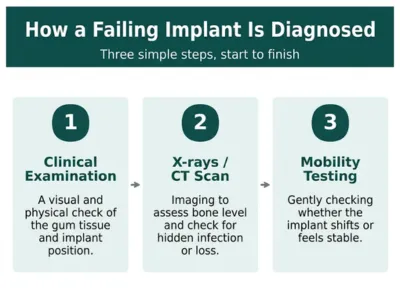
- Clinical examination: a visual and physical check of the gum tissue and the implant’s position.
- X-rays or CT scans: imaging used to assess bone levels and spot anything not visible to the eye.
- Mobility testing: gently checking whether the implant shifts under light pressure.
Treatment Options for Failed Dental Implants
No single fix applies across the board. It really comes down to why the implant is struggling in the first place, and healing takes months, not weeks, so plan for a process rather than a quick turnaround.
- Non-surgical treatment: antibiotics, professional cleaning, and deep scaling for early-stage peri-implantitis.
- Bone grafting: rebuilding lost bone so a new, stable implant has something solid to anchor to.
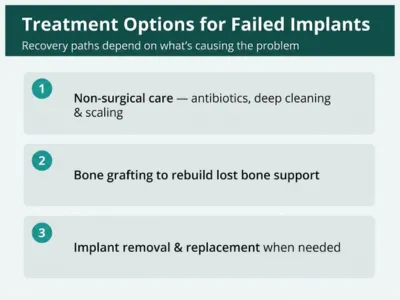
- Implant removal and replacement: used when the implant can’t be saved, followed by a replacement once the site has healed.
- Addressing the underlying cause: a night guard for bite-related issues, or treating gum disease so it doesn’t return.
Whatever's causing the problem, there's usually a path forward.
Explore implant treatment options at Enamel Dental →
How to Prevent Dental Implant Failure
Here’s the reassuring part: most of this is preventable, and none of the habits below are hard to understand. Sticking with them is really the only challenge.
- Oral hygiene practices: brushing, flossing, and cleaning around the implant every day, just as you would a natural tooth.
- Regular dental checkups: routine visits catch small problems before they turn into implant failure.
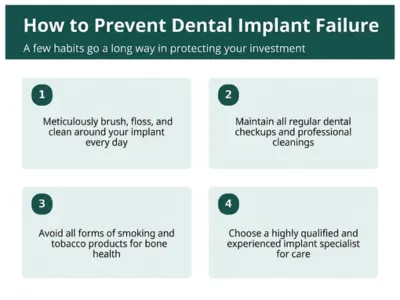
- Avoiding smoking: cutting back, or quitting altogether, noticeably improves healing and long-term success.
- Choosing an experienced implant dentist: correct placement from the very start eliminates most of the risks on this list.
Recognise one or two of these?
Get a professional evaluation at Enamel Dental →
FAQ
1. What are the early warning signs of a failing dental implant?
Lingering pain, swelling, gum redness, a sense of looseness. Any single one of these is reason enough to book a checkup, not wait around.
2. Can a failed dental implant be saved, or does it always need removal?
Depends how early it’s caught. Early-stage peri-implantitis usually responds to cleaning and antibiotics. Advanced bone loss or a genuinely loose implant, on the other hand, usually means removal first and replacement down the line.
3. How long after implant placement can failure occur?
Could be a few months in, could be years later, there’s genuinely no fixed window. That’s why ongoing care matters at every stage, not just right after surgery.
4. Is pain always present with a failing implant?
No, and that surprises most people. Some implants fail quietly, swelling or odour or looseness showing up long before any real pain does. This is exactly why regular checkups matter, they catch what pain alone would miss.
5. What is peri-implantitis, and how is it treated?
Think of it as gum disease’s version for implants, an infection and inflammation of the gum and bone around the implant. Early on, deep cleaning and antibiotics usually handle it. Further along, it might need surgery or bone grafting.
6. Can a failed implant be replaced immediately, or is there a waiting period?
Usually there’s a healing stretch after removal before a new implant goes in, longer still if bone grafting is part of the picture. Your dentist will look at the site and give you a realistic timeline, not a guess.
